Single request
Hometown Visit Guide
For your trip to the village. For a trip to Japan, when you know your ancestor's registered domicile (honseki).
Download this sample as delivered (PDF, 1.5 MB)
Hometown Visit Guide
The Ando family 安東家
A visit to Nagaiwaya, in the Kunisaki Peninsula, Oita Prefecture
| Registered domicile | Nagaiwaya, Bungo-Takada City, Oita Prefecture, Japan |
|---|---|
| Your ancestor | ANDO Kisaburō(?) (安東喜三郎), who left for Hawaii in 1905 |
| Family temple's school | Tendai (a major Buddhist school), from your family's information |
| Prepared for | [client name withheld] |
| Date | October 2026 |
Sample. The Ando family, their names and their Buddhist school are fictional. The places, temples, routes and timetables are real.
綴Koseki Roots
At a glance
- Nagaiwaya (長岩屋) is a valley in Bungo-Takada City, Oita Prefecture, around the temple Tennenji (天念寺).
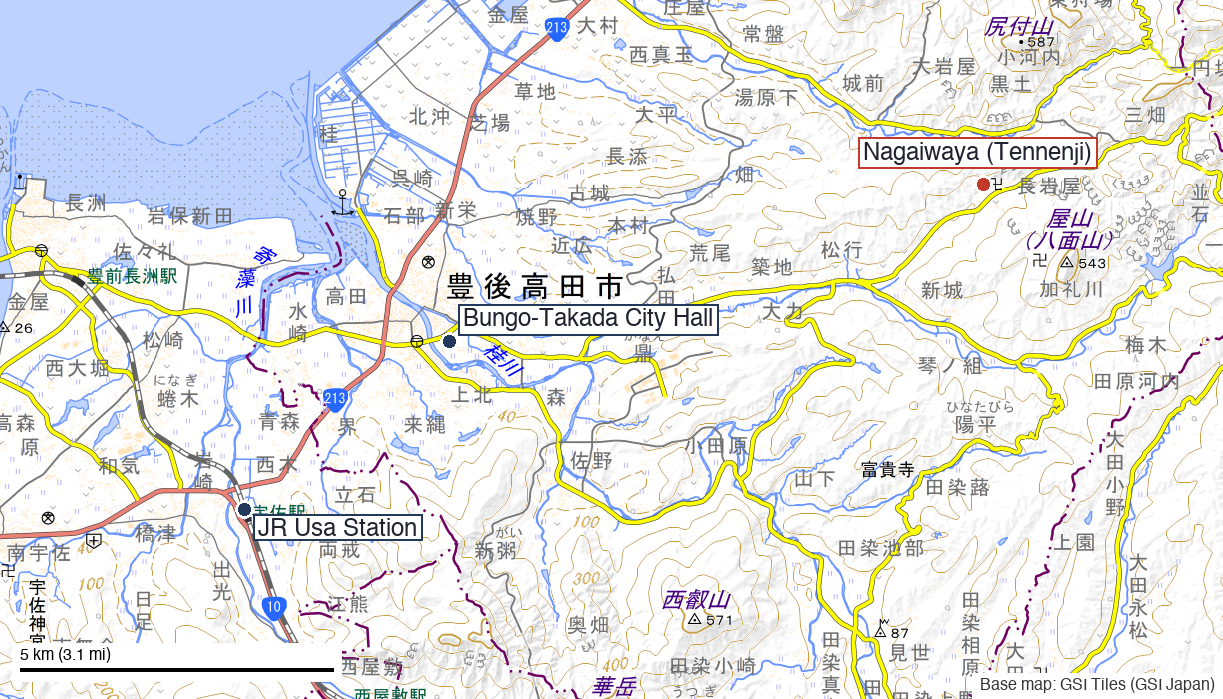
- Fly to Oita Airport or take the train to JR (Japan Railways) Usa Station. From Bungo-Takada, the village is about 15 minutes by taxi or car.
- Two Tendai Buddhist temples near the village may be your family's temple. Write to them before you go.
- Tennenji's New Year fire festival, the Shujō Onie, falls in February; the date changes each year.
- Bring the card in Japanese in section 6.
1. Where Nagaiwaya is today
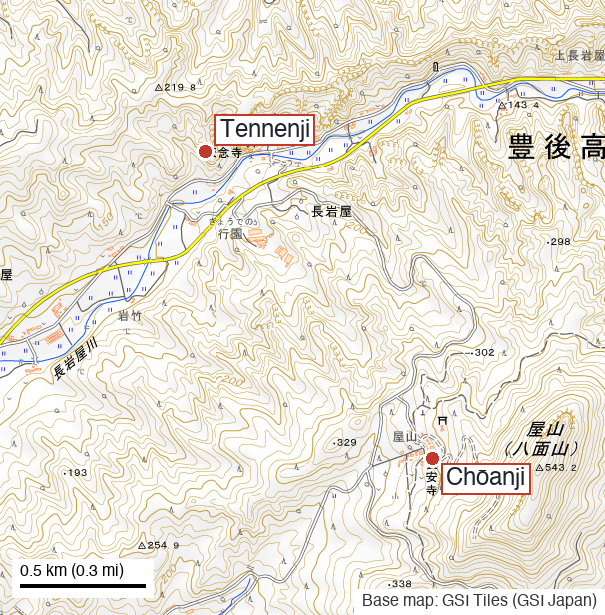
Nagaiwaya 長岩屋 is a valley in the center of the Kunisaki Peninsula, in the northeast of Kyushu (Japan's southwestern main island). Today it is part of Bungo-Takada City, Oita Prefecture. The valley follows the Nagaiwaya River, and the village grew up in front of the temple Tennenji 天念寺 (-ji means "temple"). On the maps we mark the village by Tennenji, a public place, rather than by your family's lot number.
2. The village in brief
Tennenji belongs to Rokugō Manzan 六郷満山, a network of Tendai Buddhist mountain temples unique to the Kunisaki Peninsula. Tendai is one of Japan's major Buddhist schools. By tradition, the temple was founded in 718. In the Edo period (1603–1868), Nagaiwaya Village was part of the Shimabara domain, one of some 260 domains ruled by hereditary lords under the shogun (Japan's military ruler). Shimabara's castle was in today's Nagasaki Prefecture; this corner of Kunisaki was one of its detached holdings.
In 1889 Nagaiwaya joined four other villages to form Nishi-Tomiku Village. In 1951 Nishi-Tomiku became part of Takada Town, and in 1954 the town became Bungo-Takada City. In 2005 the city merged with the towns of Matama and Kakaji. Your ancestor's register may give any of these names, depending on its date.
On October 1, 1941, a heavy rainstorm swept away Tennenji's main hall and the priests' quarters. The lecture hall and the small shrine beside it still stand. The temple's main image is a standing wooden statue of Amida Buddha (the Buddha of the Pure Land). It is on display in the Onie no Sato History Museum (鬼会の里歴史資料館) next to the temple. The museum presents the temple's New Year fire festival and the Buddhist culture of Rokugō Manzan.
Every year, Tennenji holds the Shujō Onie, a New Year fire festival with dancers dressed as demons. It falls on the 7th day of the 1st month of the old lunar calendar (used in Japan until 1872). The Western date changes each year; in 2026 it was February 23.
In 1977 the Shujō Onie of Tennenji and of two other temples on the peninsula, Iwatoji 岩戸寺 and Jōbutsuji 成仏寺, was designated an Important Intangible Folk Cultural Property of Japan. The cliffs above the temple, Tennenji-yaba and Mudōji-yaba, have been a National Place of Scenic Beauty since 2017 (yaba: a gorge of towering rock formations; Mudōji 無動寺 is a temple). In 2024 Tennenji and Chōanji were included in the National Historic Site "Rokugōsan."
3. Temples that may be your family temple
Your family's information says the household belonged to the Tendai school. The two Tendai temples nearest the village are listed below. Both are candidates. The temple's death register (kakochō, its book of the dead) or your family's memorial tablets (ihai, kept on the family altar) may show which temple your family belonged to.
| Temple (mountain name; -san = "mountain") | Address | Notes |
|---|---|---|
| Tennenji 天念寺 (Nagaiwaya-san) | 1152 Nagaiwaya, Bungo-Takada City 大分県豊後高田市長岩屋1152 | Tendai. In the village itself. Parking for 40 cars. |
| Chōanji 長安寺 (Kongō-san) | 635 Karegawa, Bungo-Takada City 大分県豊後高田市加礼川635 | Tendai. About 1.5 km (0.9 mi) south of Tennenji. Open 8 a.m. to 5 p.m. The Tarōten statues (images of a guardian deity of the Rokugō Manzan temples; Important Cultural Property) can be seen for ¥300 (about US$2). |
How to contact a temple
We suggest you write before you go, so that the temple can expect you.
- Write a short letter in Japanese. Give your ancestor's name in kanji (Chinese characters; 安東喜三郎), his dates (born 1882, left for Hawaii in 1905), the registered domicile, your relationship to him, and the dates of your visit.
- Ask whether the temple holds the graves or the death register of the Ando family of Nagaiwaya, and whether you may visit. A temple may decline to show its death register.
- Send the letter to the address above, with your email address. Allow several weeks for a reply.
- For questions about the heritage sites, the Bungo-Takada City Cultural Properties Office can help. For travel, the city's tourism association runs the official tourism site (see Sources).
We do not contact temples or relatives for you; this guide tells you how. In the guide we prepare for your family, we write the letter in Japanese for you to copy, sign and send.
4. Getting there
To Bungo-Takada
- By air: fly to Oita Airport. The North Liner bus runs to the Bungo-Takada bus terminal in about 50 minutes for ¥1,400 (about US$9). No reservation is needed.
- By train: take the JR Nippō Main Line (the line along Kyushu's east coast) to Usa Station. By limited express, Usa is about 1 hour 35 minutes from Hakata (Fukuoka), about 50 minutes from Kokura (in Kitakyushu) and about 40 minutes from Oita. From the bus stop on your left as you leave Usa Station, an Oita Kotsu Hokubu (a local bus company) bus reaches the Bungo-Takada bus terminal in about 10 minutes.
From Bungo-Takada to Nagaiwaya
- By car or taxi: about 15 minutes from the Shōwa Roman-gura ("Shōwa Romantic Warehouse"), the tourist center in the old town (named after the Shōwa era, 1926–89). Four taxi companies serve the city. The shared taxi below (a city-run taxi on a fixed route and timetable) has no return trip the same day. To visit and return the same day, take a taxi or rent a car.
- By the city's shared taxi: the Nagaiwaya line stops at Tennenji, ¥200 (about US$1.30) a ride, open to visitors. It runs only on Thursdays and Saturdays. The one trip from town leaves the Chamber of Commerce and Industry stop at 11:25 a.m. and reaches Tennenji at 11:56 a.m. There is no return trip to town the same day. (Timetable of April 1, 2026.)
5. On the day
- The shared taxi does not run on Sundays, national holidays or from December 31 to January 3, and it may stop in heavy rain, typhoons or snow.
- The mountain paths along the cliffs above Tennenji are closed to the public because they are dangerous.
- At a temple, speak quietly, take off your shoes where asked, and follow any "no photos" signs. To put out the flame on a stick of incense, wave it; do not blow on it.
- If you plan your trip around the Shujō Onie, check the date for your year with the city; it follows the lunar calendar.
- Carry the card below, and the letter from the temple if you received one.
6. A card to show in Japanese
Print this card and show it to people you meet in the village. It says who you are and what you are looking for, politely, in plain Japanese.
先祖の家を探しています。
私はハワイの日系人です。先祖の安東喜三郎は、明治三十八年(一九〇五年)に、ここ長岩屋からハワイへ渡りました。
安東家のお墓や、家のあった所をご存じでしたら、教えていただけませんか。日本語はほとんど話せません。どうぞよろしくお願いいたします。
In English: "I am looking for my ancestors' home. I am a Japanese American from Hawaii. My ancestor ANDO Kisaburō left here, Nagaiwaya, for Hawaii in 1905 (Meiji 38). If you know where the Ando family's graves are, or where their house stood, could you please tell me? I speak very little Japanese. Thank you very much for your help."
What this guide does not do
We do not contact temples, relatives or offices for you, and we do not prepare papers for government offices. If you want your ancestor's koseki, the Bungo-Takada City office accepts requests by mail; a Roots Report includes a request guide written for your family. We do not provide information about the status or reputation of a neighborhood. A visit on your behalf is a separate service, quoted separately for each visit.
Sources
- Maps: GSI Tiles (standard map), Geospatial Information Authority of Japan, maps.gsi.go.jp/development/ichiran.html. We added the labels and the scale bar. Locations of Tennenji, Chōanji and Bungo-Takada City Hall from the GSI place-name search; Usa Station from the coordinates in Japanese Wikipedia. Distances are straight-line distances we measured between these points.
- Tennenji: Bungo-Takada City, official tourism site, "Tennenji", and the city's page "Tennenji" (both in Japanese). These give the address, the 1941 rainstorm, the lecture hall and the shrine, the museum, the parking and the 15-minute drive. Founded in 718 by tradition, and a head temple of the "middle mountain" (second) rank of Rokugō Manzan: the same pages and Oita Prefecture's tourism site, visit-oita.jp. Tendai school: Japanese Wikipedia, "Tennenji".
- Shujō Onie: date by the lunar calendar and February 23, 2026: Bungo-Takada City; designated May 17, 1977, with the preservation societies of Nagaiwaya, Iwatoji and Jōbutsuji: Agency for Cultural Affairs, Cultural Heritage Online.
- Tennenji-yaba and Mudōji-yaba, National Place of Scenic Beauty (2017), and the closed mountain paths: Bungo-Takada City, Cultural Properties. National Historic Site "Rokugōsan" (2024): Bungo-Takada City, Cultural Properties. Cultural Properties Office: contact page (all in Japanese).
- Chōanji: address, opening hours, the Tarōten statues and the fee: Bungo-Takada City, official tourism site (in Japanese).
- Nishi-Tomiku Village (1889–1951) and the mergers of 1951 and 1954: Japanese Wikipedia, "Nishi-Tomiku Village", citing the standard dictionaries of municipal names; the 2005 merger: Bungo-Takada City. The Shimabara domain: our sample Roots Report, section 4.
- Usa Station on the JR Nippō Main Line: JR Kyushu. Travel times by limited express: Bungo-Takada City (in Japanese).
- The bus from Usa Station: official tourism site. The North Liner from Oita Airport, with the fare and the timetable for October 2026: Bungo-Takada City (both in Japanese).
- The shared taxi: Bungo-Takada City and its timetable of April 1, 2026 (PDF). Taxi companies: official tourism site (all in Japanese).
- Temple manners: Japan National Tourism Organization, "Shrine and temple traditions".
- Koseki requests by mail: Bungo-Takada City, Citizens Division (in Japanese). Tourism: official tourism site of Bungo-Takada, run by the city's tourism association.
Planning a trip to your ancestral village? — $390
For travelers who know their ancestor's registered domicile (honseki). If you do not know it yet, start with a Roots Report. PDF in about 2 weeks from the day you pay; please order at least 1 month before you leave.